


In Canada, taxes are an inevitable part of life — from employment income to daily spending, and even to investing and wealth management. The pressure of high taxes on individuals cannot be ignored, so finding effective ways to manage your tax burden has become a focus for many people. However, don’t worry — today we’ll introduce you to a unique Canadian tax-free investment account, the TFSA, to help you better plan your personal finances.
What is a TFSA?
Its full name is Tax-Free Savings Account, which is a personal tax-free savings account. This account can be opened at banks, insurance companies, and other financial institutions. Interest, capital gains, and dividends earned in this account are not subject to tax. Any Canadian tax resident can open a TFSA. To be eligible, you must be at least 18 years old (19 in some provinces). If you already have a TFSA but later become a non-resident for tax purposes, you can still keep the account. The income earned before you became a non-resident remains tax-free; however, any new contributions after that will be subject to a 1% monthly tax and will not accumulate new contribution room.
Keep in mind: Being a Canadian tax resident does not necessarily mean you are a Canadian citizen or permanent resident. For guidance on determining your tax residency status, refer to our article:
In addition to savings, the TFSA can hold cash, mutual funds, GICs, stocks, and bonds as investment products. However, avoid excessive trading — doing so may be considered business activity by the CRA, triggering tax obligations.
Naturally, such a favourable program comes with limits. You can only contribute up to your annual contribution limit. This limit accumulates over the years if unused, but the exact amount varies per individual. You can check your specific limit in your CRA account. For a rough idea, we’ve also provided a reference chart for estimation.
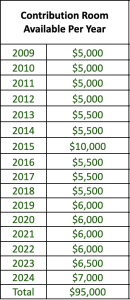
Here are some common questions about TFSA contribution limits:
1. What if I exceed my TFSA contribution limit?
The CRA will charge a 1% monthly tax on the excess amount.
Example: If you exceed your limit by $5,000, the CRA will charge $50 per month (5,000 × 1% = $50).
2. How can I avoid exceeding the limit?
Always check your available contribution room before making a deposit. Note that if you withdraw money from your TFSA during the year, you cannot re-contribute it in the same year.
Example: If your total TFSA limit is $20,000 and you withdraw $10,000 this year, you cannot re-deposit that $10,000 until January 1 of the following year.
3. What if I haven’t used up my limit?
You can keep contributing until you reach your maximum limit.
Example: If your total TFSA limit is $20,000 and you’ve contributed $15,000, you can still add $5,000 this year.
4. If my investments in the TFSA grow or lose value but I don’t withdraw, will it affect my limit?
No, it won’t.
5. If my investments in the TFSA grow or lose value and I withdraw, will it affect my limit?
Yes, it will. The next year’s contribution room will adjust based on the withdrawal amount.
Example: If your limit is $5,000 and you contribute $5,000, which grows to $5,500, and you withdraw all $5,500 this year, your TFSA limit next year will be $5,500 plus the new year’s limit. Similarly, if your $5,000 drops to $4,500 and you withdraw it, next year your limit will be $4,500 plus the new year’s limit.
Like a coin with two sides, let’s look at the pros and cons of a TFSA.
Advantages of a TFSA:
- Tax benefits: All investment growth inside a TFSA is tax-free — including dividends, interest, and capital gains.
- High flexibility: You can withdraw funds anytime without paying taxes or reporting it in your tax return — great for emergency funds.
- No impact on social benefits: Withdrawals don’t affect your OAS, GIS, EI, or other benefits.
- Lifetime usage: Unlike RRSPs, you can keep contributing after age 71, providing ongoing investment opportunities.
- No income requirement: Anyone can open and use a TFSA, regardless of income.
- Investment flexibility: You can hold a variety of assets, such as stocks, bonds, and mutual funds.
Overall, the TFSA offers strong flexibility, low entry requirements, tax-free growth, and no effect on other income or benefits.
Disadvantages of a TFSA:
- No tax deduction: Unlike RRSPs, TFSA contributions are not deductible from taxable income.
- Contribution limit: Annual limits may restrict larger investments.
- Not suitable for day trading: Frequent trading may be deemed business activity and taxed.
Therefore, we recommend that you assess your situation carefully and integrate the TFSA into your broader financial plan. If you have questions, click here to consult our professional advisors.
Jiaxin Wealth Management kindly reminds you that the information in this article is for reference only. When choosing a specific product, please consult a professional and select based on your actual needs to maximize your benefits. Finally, please do not take any action solely based on the information in this article. Jiaxin is not responsible for any decisions made or losses incurred as a result of using this information.