



In the past two years, Canada’s vehicle theft rate has surged, causing more than CAD $1 billion in losses to insurance companies. Compared with the previous year, the Atlantic region, including BC, rose by a full 34.5%. Terri O'Brien, President and CEO of Équité, called this a “national crisis”! And these losses are borne entirely by Canadian insurers. According to the Insurance Bureau of Canada, in Ontario alone, theft claim costs in 2022 were about CAD $700 million—nearly 300% higher than in 2018. As a result, auto insurance premiums have risen significantly, since premiums are closely tied to claims costs.
In Canada, when you buy a car, auto insurance is mandatory. So how do you choose car insurance in Vancouver? What money-saving tips are there? Today, Jiaxin Wealth Management will walk you through the details.
Basic Introduction to Auto Insurance:
In BC, auto insurance is mainly divided into two types:
ICBC is the only company that provides basic coverage, and it must be purchased when you buy a vehicle, so the price is relatively higher than in other provinces. Other insurers, such as BCAA or Canadian Direct, can provide optional coverages.
Basic coverage is a broad category and specifically includes the following five coverages:
- Enhanced Accident Benefits
This is a widely beneficial coverage. Even if you are at fault in an accident, as long as you’re injured, ICBC’s Enhanced Accident Benefits can provide all necessary medical and rehabilitation care, with no overall limit. Beyond basic medical costs, it can also include caregiving, rehabilitation expenses, and medically related transportation. If your injury prevents you from working, you may receive income replacement beginning on the eighth day after the crash. This benefit is calculated as 90% of your net income minus any amounts received from other sources. As of April 1, 2023, the maximum annual income eligible for coverage is CAD $109,000.
- Third Party Liability coverage
This means a third party’s losses are covered when you are at fault. When you are liable, the insurer will pay up to CAD $200,000 to the other party to cover medical expenses, vehicle repairs, and more. Note that after a claim, your premium will likely increase accordingly.
- Underinsured Motorist
Underinsured Motorist coverage is the counterpart to third party liability. It applies when the other driver is at fault and their insurance is insufficient to cover your losses. This coverage pays the shortfall. Although it seems to cover the other side, it ultimately protects your interests. Whether you’re renting a car or driving your own, all occupants are covered, with a maximum payout of CAD $1 million per person—giving you and your family peace of mind.
- Hit-and-run damage and injuries
If you suffer injury or property damage in a hit-and-run, even as a pedestrian, you can receive up to CAD $200,000 in compensation.
- Inverse liability protection
Laws vary across North America. If you have an accident outside your area and local laws are not favorable to you, this coverage will compensate you according to your share of non-fault. For example, if you are 40% at fault, it would compensate 60% of your repair costs.
Having reviewed basic coverage, let’s look at optional coverages. As the name suggests, there are many types, so choose based on your needs. Below are some common ones.
- Collision coverage
Collisions happen—sometimes you hit others, sometimes others hit you. Collision coverage primarily pays for towing, repairs, and other costs after a crash. Even if you are at fault, collision can cover your vehicle’s damage. If you are found partially at fault, basic coverage will pay for the not-at-fault portion, while collision can cover the rest. If you are 25% or more at fault, your claim may lead to a premium increase.
- Loss of use
Repairs take time. If you need a vehicle during that period, loss-of-use coverage can pay for a rental car, taxis, or public transit expenses.
- Extended Third Party Liability
Like the third party liability in basic coverage, if you’re worried CAD $200,000 isn’t enough, you can purchase this coverage to raise your liability limits up to CAD $5 million.
- Comprehensive Coverage
Beyond collisions, vehicles face many other risks—such as theft and natural disasters. Comprehensive coverage pays for losses other than collision. In Canada, you may occasionally encounter wildlife on the road; damage caused by animals is also covered.
How Are Premiums Calculated?
After understanding the coverage types, you may ask: how much will the premium be? The specifics depend on your own situation, and each policyholder’s premium is assessed within ICBC’s internal system. Here, based on some new ICBC policies after June 2023, we offer a general reference.
- Drivers
Starting September 1, 2019, ICBC overhauled premium calculations—accidents are now tied to drivers rather than vehicles/owners, with greater emphasis on the driver’s record and behavior.
First, you must list the principal driver (75% weight in pricing)—the person who will drive the vehicle the most during the policy period. If you fail to designate the principal driver, you may breach your insurance contract, which can lead to denied claims for vehicle damage and potential extra charges.
Second, ICBC requires you to list each occasional driver (the worst driver accounts for 25% of pricing), including family, friends, and anyone likely to drive your car. Also be cautious when lending your car. If the driver is not listed and you have not purchased Unlisted Driver Protection, you may have to bear additional losses.
- Past accidents
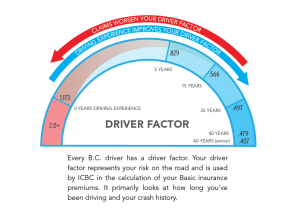
Lower risk usually means discounts. Fewer accidents and longer driving history typically lead to lower premiums. To determine accident history, ICBC looks at your last 10 years of claims. However, the new system does not count accidents before March 1, 2017, so those won’t affect future insurance.
- Vehicle details
Your vehicle’s model, brand, and year impact its safety profile and naturally affect the total cost of insurance—especially optional coverages—so this is an important factor.
Different auto insurance categories include:
- Regular on-road insurance (with plates)
- Temporary operating permit (no plates, only temporary policy dates)
- Garage policy
- Place of residence
ICBC segments regions by geography and population. If you live in a sparsely populated area with good road conditions and fewer accidents, premiums tend to be lower. If you report the wrong area, your claim may be denied or you may be fined.
- Vehicle use
ICBC needs to understand how you use your vehicle to assess risk—for example, commuting, school drop-offs, business use, deliveries, or other purposes (trades, taxis). Different uses lead to different premiums. Typical categories include: pleasure, commuting with a one-way distance below/above 15 km, business, delivery, and other specialized uses.
How Are Discounts Assessed?
Beyond the factors above, the following may also reduce your premium:
1. If your vehicle travels fewer than 5,000 km in a year, you may qualify for a 10% discount on Basic, Extended Third Party Liability, and Collision. You’ll just need to provide an odometer photo at renewal;
2. If you have a clean local driving record for the past 9 years without accidents—i.e., a “conscientious veteran driver”—or your driving experience exceeds 40 years, you may enjoy the highest Basic discount;
3. If your vehicle has factory-installed Autonomous Emergency Braking (AEB), you can receive a 10% discount;
4. If your vehicle has a passive electronic anti-theft device, you can also save on premiums;
5. If you insure five or more vehicles at once for commercial use, you can save up to 63% on premiums;
6. A deductible is standard—typically between CAD $300 and $2,500. The higher the deductible, the lower the premium, though generally it’s not recommended to raise it above CAD $2,000.
7. Finally, if the principal driver has certain disabilities, they may be eligible for a 25% discount on Basic coverage.
Accident Claims:
After a car accident, if there are injuries, call 9-1-1 immediately. If there are no injuries, you can call ICBC’s English line at 604-520-8222, the Chinese line at 1-855-813-2121, or file online. Before calling or filing online, prepare the following::
- Date, time, and location of the accident
- License plate numbers of all vehicles involved
- Driver’s license numbers for each driver
- Vehicle insurance information
- Witness information
- Police file number (if created)
- Photos or videos of the scene as evidence for future claims
ICBC claims phone numbers:
- Metro Vancouver: 604-520-8222
- Toll-free: 1-800-910-4222
- Chinese service line: 1-855-813-2121
Chinese service website: https://www.icbc.com/Pages/cn/default.aspx
Online claims: https://www.icbc.com/claims/report-view/Pages/Report-a-claim-online.aspx
In Canada, auto insurance is essential for every car owner. We hope this information helps you better understand premium factors and choose the coverage that suits you. If you have any questions or need further consultation, feel free to contact us—Jiaxin’s professional insurance advisors are ready to help.
*With market or policy changes, this article is for reference only. Jiaxin is not responsible for any decisions or losses arising from reliance on this information.