



In the current market environment, more and more people are concerned about how to preserve their wealth and provide security for themselves and their families in the future. If, on top of preserving assets, you could also earn some returns, that would be perfect. Is there such an option? Yes, there is — participating life insurance. It is a type of permanent life insurance that not only provides an insurance payout when needed but also allows you to share in the insurance company's profits and gain investment returns.
What is Participating Life Insurance?
First, let’s understand what participating life insurance is. In Chinese, it means you can take part in the company’s profit distribution. From its English name, “Participating Life Insurance,” it has two layers of meaning: “Participating” reflects its financial nature — policyholders can share in the insurer’s investment profits; “Life Insurance” refers to the traditional insurance feature — a form of life coverage.
The participating account is usually managed separately. Part of the premium is used to cover the insurance benefits, while the rest is invested in bonds, stocks, real estate, and other projects. The insurance company will strive to ensure that the account’s growth covers expenses and meets current and future obligations to policyholders. If the investments in the participating account generate profits, the policyholder can enjoy dividends.
Ways to Receive Dividends
Generally, policyholders have four flexible options for handling dividends from the insurer:
Cash Payments: Withdraw the dividends as cash each year.
Dividends on Deposit: Accumulate the dividends to earn compound interest; coverage amount remains unchanged.
Annual Premium Reduction: Use dividends to pay premiums.
Paid-up Additional Insurance: Use dividends to purchase additional coverage, increasing both the death benefit and future dividends, resulting in overall growth in both cash value and coverage.
Advantages of Participating Life Insurance
Participating life insurance offers the following benefits:
1. Life Insurance Protection
Participating life insurance is, at its core, life insurance, providing a substantial death benefit. If the insured passes away, the beneficiary will receive at least the policy’s guaranteed payout. Even if the insured has large debts, the insurance proceeds can be left to the family without being used to repay creditors. Both the cash value and the payout are protected under Canadian law from creditor claims. Another advantage is that dividends can be added to the policy, so the coverage amount increases over time.
2. Tax-Deferred Wealth Management
In typical investments, annual gains are subject to capital gains tax, but the investment growth inside a participating life insurance policy is not taxed in the year it occurs. Moreover, the investment portion is managed by top industry professionals, giving you peace of mind. From the chart below (from Sun Life), you can see that compared with stock indexes, participating life insurance returns are very stable, higher than other investment types, and even outperform government bonds, GICs, and CPI. Since dividends compound over time, the policy’s cash value steadily increases, making this a rare and valuable product from a financial planning perspective.
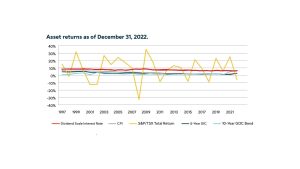
(Chart lines indicate:)
*Red: Dividend Rate
*Gray: Consumer Price Index (CPI)
*Yellow: S&P/TSX Total Return
*Dark Blue: 5-year GIC
*Light Blue: 10-year Government Bonds
3. Peace of Mind in Retirement
Canada’s high-tax system means retirement planning must be strategic. The growing cash value in participating life insurance can serve as retirement income without being counted as taxable income, thus avoiding additional taxes and not affecting government benefits. Over time, the cash value grows substantially, and withdrawals are flexible, making it a viable retirement income source.
4. Efficient Wealth Transfer
The longer the coverage remains in force, the larger the death benefit becomes, allowing more tax-free wealth to be passed to the next generation. Any unused portion of the policy can be left to children as a tax-free death benefit.
Participating life insurance combines the strengths of insurance and investment. It provides lifelong protection, helps with wealth management, enables tax-efficient growth, and facilitates wealth transfer, making it a top choice in recent years for high-income and high-net-worth individuals.
How Participating Life Insurance Differs from Other Investments
Although participating life insurance has an investment component, it differs from traditional investments in several ways:
1. Different Purpose
Traditional investments, such as stocks, mutual funds, and real estate, can generate short-term gains. Participating life insurance, however, is a long-term tool focused on asset protection and wealth transfer. In today’s slow global economic growth, protecting existing wealth may be more important than rapid gains. As an insurance product, it cannot be withdrawn at will or quickly liquidated. The investment benefits are realized through long-term holding.
Yet it is not “just” insurance — it allows tax-sheltered growth, asset segregation, and creditor protection. For high-asset individuals and families, in cases of business failure or debt issues, the policy remains untouched by creditors, ensuring that the insured and their family still benefit from the coverage and dividends.
2. Different Risk Level
Compared with other investments, participating life insurance is more stable, with much lower volatility. Over the past 25 years, the Toronto Stock Exchange (TSX) had an average annual return of 7% but with a volatility of 16.44%; Sun Life’s participating life insurance over the same period had an average dividend rate of 7.28% and volatility of only 0.85%. Compared to GICs or government bonds, it offers similar volatility but much higher returns. Historical data also shows it consistently outperforms government bonds.
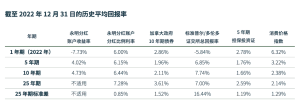
In addition, single-stock or single-property investments face market downturn risks. For example, the S&P 500 fell about 18.7% in 2022. While long-term recovery is possible, it is difficult for ordinary investors to beat participating life insurance’s stable dividend rate in the short term. Thus, considering both volatility and returns, participating life insurance offers a prudent investment approach.
* Data source: Personal Finance
3. Different After-Tax Returns
Cash-value life insurance is tax-exempt, whereas other investments are subject to capital gains tax, resulting in different after-tax yields. For example, if the internal rate of return (IRR) on a death benefit is 5%, another taxable investment would need to yield 7.5% or more to match it after tax. For stocks sold annually, the return would need to be about 9.2% to match a tax-free 5% IRR from participating life insurance.
4. Different Product Structure
Participating life insurance involves complex factors such as dividend rates and cash value. It cannot be evaluated solely by premium amount. For example, depositing $10,000 in a bank at 2% interest earns $200 annually. But a $10,000 first-year premium with a 6% dividend rate does not mean $600 in dividends the first year, as insurance costs must be considered. For personalized calculations and recommendations, please contact our advisors at Jiaxin Wealth Management.
Owning participating life insurance does not conflict with other investments. It can be part of a diversified portfolio including protection assets (e.g., permanent insurance with cash value), liquid assets (e.g., savings and mutual funds), fixed-income assets (e.g., short- and long-term bonds, rental property), and equity assets (e.g., stocks, equity funds), helping to spread risk and optimize asset allocation.
Jiaxin Wealth Management reminds readers that this article is for reference only. Insurance products and figures may change with market conditions, and each insurer’s plans and claims processes differ. We recommend consulting a professional insurance advisor to choose the right policy for your needs. This article does not constitute investment advice, and Jiaxin is not responsible for any decisions or losses resulting from its use.