



To help Canadian citizens plan their finances and taxes more efficiently, the Government of Canada offers a a variety of investment options The Government of Canada offers a variety of investment options, such as ordinary Non-Registered Investment Accounts (NRIAs), Registered Retirement Savings Plans (RRSPs), Tax-Free Accounts (TFSAs), Registered Education Savings Plans (RESPs), and Life Insurance. These accounts not only provide individuals and families with flexible ways to save and invest, but also help optimize tax liability, thus ensuring that money is used efficiently when it counts. They have different advantages and disadvantages and are suitable for different people, so how exactly should people choose and match them? After reading this article, you may find the answer.
RESP
RESP's are Registered Education Savings Plans, a benefit for Canadian children. Parents can open an RESP account for their child and save to fund their child's education. In addition to the principal of your savings, the account contains several other government-provided benefits.
Canada Education Savings Grant (CESG): A grant of 20% of your annual contribution, with a maximum grant of $500 per beneficiary per year and a lifetime grant limit of $7,200 per beneficiary. The maximum benefit is $500 per beneficiary per year and $7,200 per beneficiary for life.
Canada Learning Bond (CLB) This is primarily for children from low-income families born in 2004 or later. Once an RESP is opened, the government gives a $500 grant, and $100 is deposited into the account each year thereafter until the child is 15 years old, for a total of $2,000. The total amount deposited is $2,000, but if the child does not obtain a higher education, the grant will be refunded.
Additional education grants : For example, the B.C. Training and Education Savings Grant (BCTESG). Children born on or after January 1, 2006 are eligible for a $1,200 study grant, which is available after the child's sixth birthday and up to the age of nine.
Like RRSPs and TFSAs, RESPs also have tax advantages. When withdrawing money from an RESP, your own principal, which is your deposit, is not taxed. But earnings and grants are taxable. Because these taxes will be paid by the child, students usually have no other income and will have a tax allowance, so will pay very little or no tax. The RESP is aimed at the child's higher education, so there are certain requirements for institutions, which can be viewed on the CRA website.
TFSA
A TFSA is an individual tax-free savings account for people with stable investment needs. The account can be opened at banks, insurance companies, and other financial institutions, and the account Although the principal amount invested is not tax deductible, the The principal amount invested in the account is not tax deductible, but the interest, capital gains and dividends generated are not taxable. As long as you have a valid social security number and are a Canadian tax resident, you can open a TFSA.
This account has a high degree of access flexibility and a low threshold for application. At the same time, both investment income and wealth inheritance, enjoy tax-free benefits, and will not affect other income and insurance plans. However, it's important to note that there is a limit on the amount of money you can put into your TFSA account each year, known as the "Contribution Limit". Contribution limits can be accrued from year to year, but each person's limit may be different, and you can check your contribution limit in your CRA account. You can check your contribution limit in your CRA account. Check the limit each time you make a contribution, and especially note that if you take money out of your TFSA account in the current year, you can't put it back in that year.
RRSP
An RRSP is a retirement savings program, and when you contribute money to your RRSP account, that money is deducted from your annual taxable income. This means that your taxable income for the year is reduced and your tax rate can be lowered. In other words, by investing in an RRSP, you are saving for retirement and reducing your current tax burden at the same time.
RRSPs also have annual limits, but unlike TFSAs, which are tax-free, investment earnings and withdrawals are tax-deferred, and taxable if passed on.RRSP contributions are usually 18% of the previous year's Earned Income, or up to a government-imposed limit. Contributions can be accumulated if they have not been used before. You can find out more by visiting your CRA account. Before age 71, money in your RRSP can be withdrawn at any time, and the money withdrawn will be taxed as that year's income. However, after age 71, if it has not been withdrawn, it must be transferred to a RRIF, and a certain amount must be withdrawn from the RRIF each year and automatically included in the individual's income for tax purposes.
However, one of the key advantages of an RRSP is that it is particularly suited to those who are currently in a higher tax bracket. If you are currently in a higher tax bracket and expect to be in a lower tax bracket in retirement, then choosing an RRSP will be a great fit.
Non-Registered Non-Registered Investment Account
This account is the ordinary investment account, which is best suited for flexible investments and therefore does not have a limit. But accordingly, it is taxable, regardless of the operations carried out. The amount earned is subject to personal income tax as capital gains The account is taxable as capital gains. In addition, in terms of inheritance, this account will incur Probate Fee, which is the cost of probate. Other accounts that name beneficiaries are not subject to liquidation tax.
participating life insurance
Participating Life insurance is a financial tool that combines protection and investment. The most important feature of this type of insurance is that it enjoys tax exemption on investments and claims, meaning that you are not taxed on the appreciation of your investments, money withdrawn or property passed on to your family. In addition to this, you will receive policy dividends, the Premiums deposited can also generate cash value and this income is also tax-free. In the long run, participating life insurance not only provides life protection, but is also an excellent tax-sheltered financial tool, making it ideal for family financial protection as well as part of the retirement legacy.
In short, these investment accounts have their own advantages and disadvantages and are suitable for different target groups. Below, we will compare them visually in terms of investment limits, returns, etc. through a table comparison.
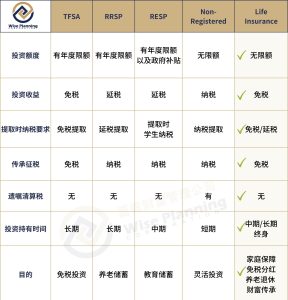
Different investment accounts have different uses and advantages. rRSP focuses on retirement planning, allowing individuals to save and invest in a tax-deferred manner until retirement when they can withdraw and pay taxes at a lower rate for tax optimization. tFSA accounts are highly flexible, offer tax benefits, and also have a low application threshold, so medium/long-term investments can be considered. resP focuses on education savings. RESPs are designed to encourage families to save for their children's education through government subsidies and tax incentives. Non-registered accounts are the most flexible and have no limits, but are tax cumbersome. On the other hand, life insurance provides health protection as well as investment attributes, and has the added advantage of wealth inheritance, contributing to family financial security.
Therefore, it is important to understand the key features and benefits of these investment accounts and have the flexibility to utilize them. To give a few examples, a young person who is new to the workforce and still struggling may prefer TFSAs as well as term life insurance for short-term family protection and financial accumulation at this stage, while a middle-aged person with a desirable and stable income may pay more attention to participating life insurance and RRSPs for long-term financial planning and retirement legacy. For families with children, RESP may be a good choice as it helps to provide financial protection for children's future education expenses. And for business owners, tax planning as well as family wealth inheritance through the purchase of business or personal life insurance can be essential.
Which investment account you choose should depend on your personal financial goals and circumstances. We recommend that you consider all factors and combine them with other financial planning before making a choice. If you have any questions, you are welcome to click on the link to consult our professional advisors at Charles Schwab.
Charles Schwab Wealth Management kindly reminds you that the information in this article is for reference only. When choosing a specific product, it is recommended that you seek the advice of a professional insurance consultant to select the appropriate program according to your actual needs in order to maximize the protection of your interests. Finally, please do not take any action based on the information in this article. Charles Schwab is not responsible for the information in this article or any choice you make or loss you incur as a result.