



The trend towards ageing is becoming more pronounced in Canada. As we age, so do we, and so do we. Therefore, the Canadian government has been committed to improving the senior care system and addressing the needs and concerns of seniors so that they can enjoy a comfortable old age. Below, we will explain Canada's pension program and welfare policy.
Canada's pension system consists of two core components: the Canada Pension Plan (CPP) and Old Age Security (OAS).The CPP pension depends on an individual's number of years of contributions and retirement age, while the OAS is a government-provided pension benefit for Canadians 65 years of age and older. citizens or permanent residents.
There are also supplementary pension schemes, such as the Guaranteed Income Supplement (GIS), which are designed to provide additional financial support to low-income older people without tax.
1. CPP
How much you get from a CPP pension depends largely on how many years you've contributed.In addition to this you must have worked within Canada and have paid CPP while working to receive it.
Typically, the claiming age for CPP is the normal retirement age of 65.
However, if you have special circumstances, you can also choose to receive it earlier (early retirement at age 60) or later (delayed retirement at age 70), only the amount of your pension will be adjusted.
In addition to this, the CPP pension is related to your average earnings throughout your working life. Let's take a simple example, if a claimant turns 65 in 2024, the maximum amount of pension that can be received is $1,364.60 per month, while as of October 2023, the average amount of CPP received by seniors over 65 is $758.32 per month.
CPP also pays attention to the disadvantaged groups by providing them with welfare policies such as disability allowance for disabled persons aged 60-64 and pension and allowance for orphans, among others.
2. OAS
The threshold for claiming OAS is that you must be 65 years of age or older and a Canadian citizen or permanent resident. It also requires Have lived in Canada for at least 10 years after turning 18. If you have not lived in Canada for 10 years, you will not receive any OAS at all; if you have lived in Canada for 40 years, you will receive the full amount of OAS.
If you have left Canada at the time of application, you need to be at least 65 years old and a Canadian citizen or permanent resident at the time of departure. In addition, you must have lived in Canada for at least 20 years after turning 18.
The amount of the OAS pension depends on the number of years you have lived in Canada. The maximum benefit is paid after 40 years of residence. If you live in the country for one more year after turning 18, you will receive 1/40th of the full pension. You receive your pension for as long as you lived in the country and it doesn't accrue after that. you can choose to defer your pension (up to 60 months) if you don't claim it at age 65. If you do not claim at age 65, you can choose to defer your pension (up to 60 months). If you do not claim at age 65, you can also choose to defer your pension (up to 60 months), and the amount will change accordingly.
Specific OAS pensions are calculated as follows:
- If the period of residence is less than 40 years, a partial benefit will be received, calculated as follows: Amount of benefit = Number of years of residence/40 * 713.34
- The amount of your pension will be reduced as your income increases and the OAS will be reduced to zero when your annual income reaches C$142,609
- If income is higher than $90,997 (in 2024), a partial repayment (clawback) of the benefit is required. Repayment = (current year income - $90,997) x 15%
It will also be adjusted accordingly in January, April, July and October of each year, depending on the growth or decline of the CPI. The current, or January through March 2024, Old Age Security (OAS) pension amounts are shown in the table below:
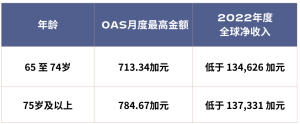
3. GIS
GIS is an additional low-income benefit. To receive the GIS pension, you must first meet the requirements for OAS, and you must live in Canada. In addition, your annual income must be below a certain income level, and the exact amount will depend on your family situation (e.g., what is your spouse's situation, etc.) The GIS is also approved once a year in January, April, July, and October, and the amounts for January to March 2024 are detailed in the table below:
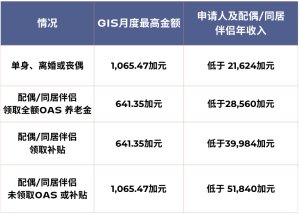
[Note] All data references as of March 2024
There are a wide variety of retirement schemes offered by the Government and a number of welfare policies, but it may be difficult to meet the needs of retirement with the Government's retirement schemes alone. Therefore, we recommend you to plan your retirement finances as early as possible to save for your old age. If the above plans cannot satisfy you, or you want to seek more protection for yourself, you can also click the link to follow our related insurance products.
Charles Schwab Wealth Management kindly reminds you that the information in this article is for reference only. When choosing a specific product, it is recommended that you seek the advice of a professional insurance consultant to select the appropriate program according to your actual needs in order to maximize the protection of your interests. Finally, please do not take any action based on the information in this article. Charles Schwab is not responsible for the information in this article or any choice you make or loss you incur as a result.